Smoke Without the Fire Alarm: How Close Can a Domestic Hob Get to Real Wok Hei?
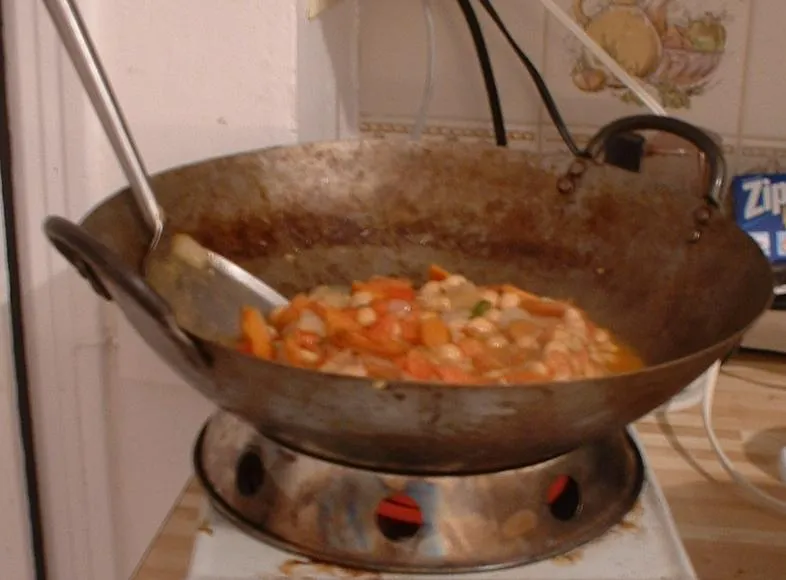
Photo: User Aarchiba on en.wikipedia, Public domain, via Wikimedia Commons
You know the smell. It hits you about four paces from the takeaway door — charred, toasty, faintly oily, impossible to place. It clings to your coat for the rest of the evening. That's wok hei, Cantonese for 'breath of the wok', and it is the single biggest gap between a decent homemade stir-fry and the £9.50 polystyrene box down the road.
So I spent a fortnight trying to close that gap, using a domestic hob, a carbon steel wok, a non-stick pan, a cast-iron skillet, and a smoke alarm with strong opinions.
What wok hei actually is
Strip away the poetry and three things are happening at once. First, very high heat is driving Maillard browning and caramelisation across a lot of surface area, very fast. Second, tiny droplets of oil are being vaporised and partially oxidised above the food — that's the 'smoke' in the name, and it's arguably more aroma than flavour. Third, everything is kept dry: water on the surface of noodles or meat steams instead of browning, and steam is the enemy of char.
The other ingredient is movement. Constant tossing keeps food in contact with the hottest part of the metal in short bursts, so it browns without sitting still long enough to burn or weep.
The problem with a British kitchen
A commercial wok burner in a Chinatown kitchen kicks out somewhere between 15 and 30 kilowatts. Your gas hob is probably pushing 2.5 to 4. The fanciest induction zone in the average new-build tops out around 3.7, and even then it's heating the base of the pan rather than roaring flames up the sides.
That's not a small deficit. But it's not the whole story either, because the pan matters as much as the burner — and most of us are cooking batches that are far too big.
The set-up
The dish: beef ho fun, the flat rice noodle stir-fry that lives or dies on char. Same ingredients, same quantities, three pans, three nights. Then a second round with egg fried rice as a control test.
- The carbon steel wok — £28 from an Asian supermarket, flat-bottomed so it works on induction, seasoned over a fortnight with a thin film of oil and a lot of patience.
- The non-stick wok — £25, three years old, coating still intact but starting to look tired around the rim.
- The cast-iron skillet — £35, inherited, heavier than a small child.
The first thing to say is that the non-stick pan never had a chance. Non-stick coatings start breaking down around 260°C, and to get anywhere near wok hei you need an empty pan that's just begun to smoke. Preheating a non-stick surface to that point is a bad idea on health grounds, a bad idea on financial grounds, and produces no char anyway, because a coated surface can't develop the screaming-hot, slightly tacky zones that catch the edges of a noodle.
How it went
The carbon steel wok produced the closest thing I've managed at home. Preheated dry until a wisp of smoke appeared, oil swirled round, beef in a single layer for about 45 seconds, then out. Noodles in, spread flat for 30 seconds, then tossed. There was real, identifiable char on the edges of the noodles — patchy and uneven, which is exactly what you want. Best of the three, and not close.
The cast-iron skillet was the surprise. It retains heat ferociously and gave a beautiful sear on the beef, arguably better than the wok. The problem came afterwards: it's too heavy to toss, it doesn't have the curved sides to catch food, and it takes an age to recover between batches. I ended up with excellent beef and slightly damp noodles.
The non-stick pan gave what non-stick pans give: a competent, tender, entirely unsmoky stir-fry. Nothing brown, nothing burnt, nothing to remember. If you're cooking for a toddler, that's a feature. If you want wok hei, it's a dead end.
What actually made the difference
Most of my gain came from changing how I cooked, not what I cooked in. In rough order of impact:
- Smaller batches. I'd been cooking three portions in one go. One portion at a time more than doubled the char. This is the single most useful change and it costs nothing.
- Preheat properly. Dry pan, high heat, until it's just starting to smoke. Then oil. Then food. Getting this wrong accounts for most grey stir-fries.
- Dry your noodles and your meat. Pat beef with kitchen paper. If using fresh ho fun, separate the strands and let them air-dry for ten minutes. Water is why your noodles slide around instead of catching.
- Pick the right oil. Groundnut (around 230°C smoke point) or rice bran (nearer 250°C). Extra virgin olive oil will smoke and taste of regret.
- Keep it moving, but not constantly. Let food sit flat for half a minute to take on colour, then toss, then sit again. Endless stirring is just steaming with extra steps.
- Cook the components separately. Beef first, remove. Noodles second. Aromatics last, for seconds only. Then combine off the heat with the sauce.
- Open the windows. Genuinely. Extractor on, window open, and no tea towel anywhere near the hob.
The honest ceiling
Can a £30 pan beat a takeaway burner? No. Not ever — you're down a factor of eight on heat output, and no technique closes that entirely. What you can do is get to something like 70 per cent, which is well past the point of being worth the effort and comfortably better than most home stir-fries.
Buy carbon steel, flat-bottomed if you're on induction. Season it, abuse it, don't panic about the rust. Cook one portion at a time and accept that a proper wok hei dinner for four means four fast rounds rather than one big one.
The smoke alarm will still go off occasionally. Consider it a review.